I’ve been doing a bit of AI experimentation and NotebookLM just… well…
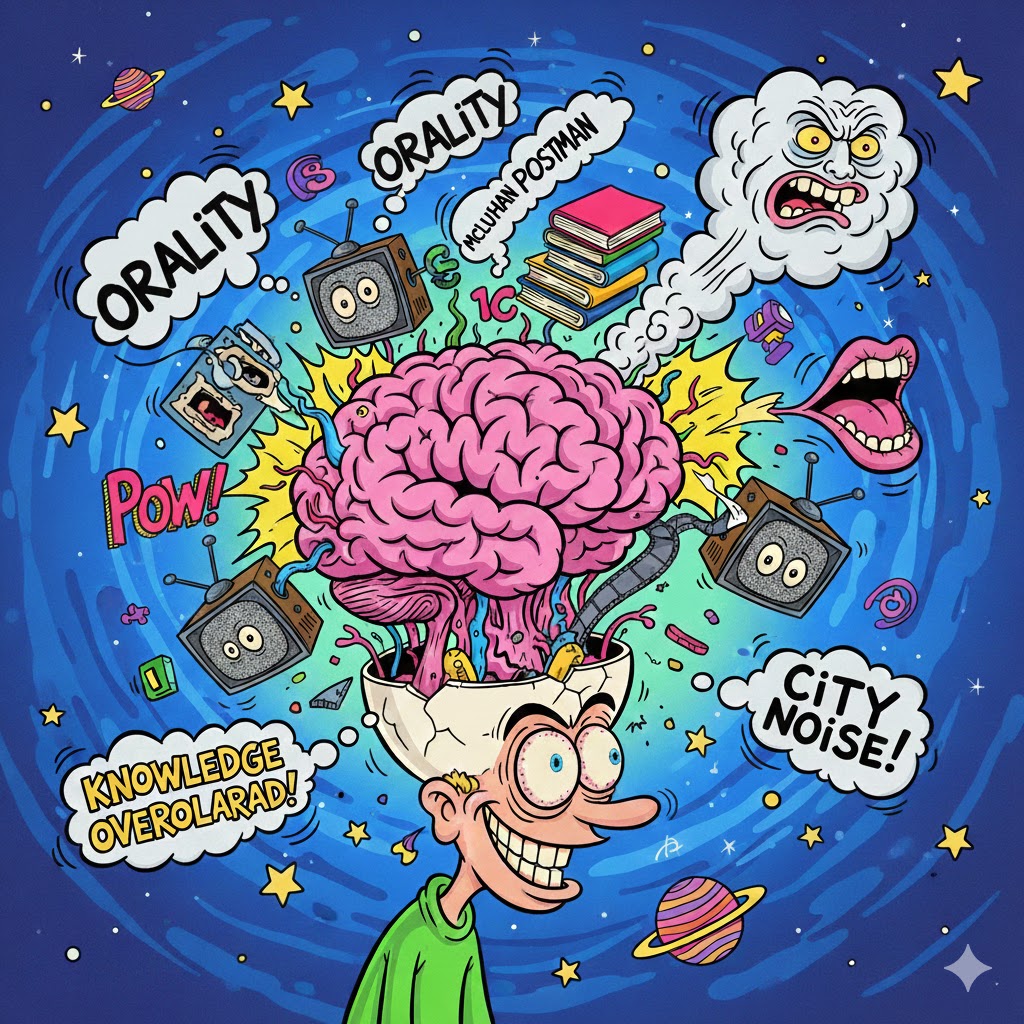
Google Gemini Generated: “Mind exploding from Orality, Postman, McLuhan knowledge”
I added McLuhan, Postman, Ong and a few other papers around media & the Gutenberg era ( 1400-1550 ) as sources, and clicked the “Audio Overview” button. I’m still in a state of shock on what it made. Enjoy.
We’re finally at the final attribute of Ong’s Psychodynamics of Orality. Even though he didn’t outline it last, I think it ties it all together.
The Interiority of Sound
Outside of sight, sound is a major sense for us. Sure there are 3 other senses, but come on…
Optical illusions can fake out our vision with perspective, relativity, reflection, translucence, or vapor our eyes can loose focus and be tricked. And when they are sound can inform us to fill in the gap.
You can echo locate with a game of Marco Polo. You can get a sense of what’s inside something simply by knocking on it – determine how hollow or dense an object is; uncover it’s insides like finding studs on a wall . The sound, and lack of sound, can give a sense of feeling based on ambient noise, resonance, or reverb, to give a “feeling” or maybe even alert to danger.
With instruments you can hear its make up of materials far away through it’s tone – the smooth and deep from the wood in a violin vs the sharp grit from the metals in a saxophone. You can hear quality, like the use of more modern, dense, plastics in vinyl records today verses the junk vinyl used as the Medium declined.
Listen to someone long enough, and you can even get a better sense of who they are. You might start to understand them more than you thought.
Reading, in contrast, is a solitary act even in a crowded room. It’s your voice inside your head echoing the words you’re seeing. Their thoughts become your thoughts. Whereas in oral traditions, you always remember the person who taught you.
“Sight isolates, sound incorporates,” as, Ong, put’s it.
Protect the Sound, Defend against Noise
However, Ong’s book was written before the internet and long before the smart phone – standing on a train car watching reams of people streaming music or video’s, all listening in isolation with their headphones intending to be a barrier.
One could argue that these devices can transform sound to isolate like a good book. We even have noise cancelling technology to further block out the world around.
However, it’s not call “sound cancelling” and, I think there’s a nuanced difference in our postliterte society between sound and noise. I think we have become acutely aware of the difference.
Technology made walking through a park more an act of blocking out and ignoring Bluetooth and cell phone speakers. It has added stop lights repeating “wait, wait”; tills with beeps and blips; musak; audio branding; gas pump ads; AIs calling us on the phone; even the wires in our walls hum all around us.
Our world is now very very noisy.
Sound is permissive. We focus in and must block out everything else to hear it.
And because of that we are pickier now than ever on who we listen to, we are also pickier who we communicate with.
There are profound feelings of vulnerability and judgement. That there is a preference on the written word or recorded image. The ability to capture many takes, revise and rewrite to come across in the most flattering light.
Radio students are scared to give live interviews. Afraid of being seen by the other person. Questioning who’s really doing the interview?
Live, immediate sound is now one the most profound experiences. Live communication has a feeling of exposure and rawness.
We even have running gags and jokes on the topic, how we no longer answer random calls or turn off all the lights in the house and duck when someone dares knock on our door.
While headphones create a cocoon against audio interaction trying to immerse in their own experience, what initially may look like isolation, I think is incorporation. Perhaps a deep connection, just not with the person next to them – instead maybe to other Swifties, or SmartLessers. The sound they are embraced in is just for another community that you, or I, aren’t a part of.
The fact that we protect ourselves so much from “noise” is evidence of how powerful sound is to our core. As we progress in our postliterate society, I think we’re going to defend and protect it even more.
Is this one of the many reasons people don’t want to go back to the office; why headphones are status symbols; why concerts are so expensive; why radio kids don’t want to do interviews; why people aren’t listening to each other?
Related/Unrelated?
Speaking of powerful audio communities, Taylor Swift’s ‘The Life of a Showgirl’ album release party “movie” was a 3-day theatrical experience and crush it over traditional movies making over $30 million domestically. It was a collective experience.
Last time we were looking at the Verbomotor Lifestyle. I wrapped up with some discovery around kids not wanting to talk, which at first seems to contradict my theory a bit.
My radio teacher did get back, we’re going to talk more, but for the moment he shared this observation, which I’ve paraphrased.
There are profound feelings of vulnerability and judgement. That there is a preference on the written word or recorded image. The ability to capture many takes, revise and rewrite to come across in the most flattering light.
It makes me think of another psychodynamic:
Orality, community and the sacral
Ong outlines that the spoken word and community become revered in a way.
He explains that the Hebrew word dabar means word and also event. Because the spoken word is an event to be cherished.
In Christianity, God never writes to anyone, he speaks. The the sermon is always out loud and spoken.
In fantasy fiction like The Lord of the Rings or The Kingkiller Chronicle, authors have picked up on this long standing sentiment, that there is this long time understood magic in the spoken word.
Perhaps, the newer aliterate generations are understanding this more than we realize.
Sacred things do give a sense of “the big feels”, the awe, and to some nervousness. Sacred things have that feeling of importance. I’ve heard many say, if it wasn’t important you wouldn’t be nervous.
The new sacral
Back to dabar. In our world of technology, a true event is an immediate, live, event. YouTube video’s and podcasts aren’t “events” until they are streaming live. Concerts, plays, presentations, all events, live, right now.
Orality is intertwined with ephemeral; immediacy; presence; the present.
And perhaps it’s technology alone, or more aliterate technology that understands the profound weight of the moment. That anything can be modified or updated so long as it’s not in the present. Even a small lag time to add a filter, or a few seconds to delete a post or bleep it out is a bit “safer”.
The Handshake – the kind of handshake that doesn’t end till the negotiation is over. The kind of handshake that’s a dance of business. The kind that someone judges characters with. Not only words. I think that type of handshake is a great symbol of verbomotor.
While Ong doesn’t lay it out specifically, verbomotor is words with action.
To the literate observer, it ends up looking like a lot of unnecessary talking. To the oral one, it’s the proper back and forth to uncover real meaning.
Ong uses a specific story based on a visitor to Cork, Ireland, a region in a country where it’s though to have “massive residual orality.”
“[A] visitor saw a Corkman leaning against the post office. He went up to him, pounded with his hand on the post office wall next to the Corkman’s shoulder, and asked ‘Is this the post office?’ The Corkman was not taken in. He looked at the questioner quietly and with great concern: ‘ ‘Twouldn’t be a postage stamp you were lookin’ for, would it?’”
It wasn’t treated as a simple yes or no answer. There was no aggressive “what’s it to you?”. The response was a carefully thought and a legitimate question to a question.
The answer to which would be very revealing on wants and needs from the person asking.
Words without Action
Maybe if it was a question on it’s own, the result may have been simpler? The fact that the visitor needed to pound, or touch the building is what gave rise to a that specific call and response.
Only through radio or podcast can we imagine words without action. They are rhetorical: no answer or response required, unless extremely compelled and moved.
Words without action require no action, not even mental storage. They are here, herd and likely forgotten.
In radio school we were taught to always activate the “theater of the mind.” That’s where the connection is.
With verbomotor, it is. Only with theater of the mind can you imagine a corollary action. If you can connect the words being spoken to an action there’s a higher chance the message is retained and acted upon.
A note about written action words
You might be thinking, but books are full of descriptive actions. That’s what makes them great! You can read the words and the actions… that should be verbomotor enough, right?
Let’s callback to this post about “close to the human lifeworld“. About the Iliad and all the physical language to engage oral minds.
The use of the physical words were to appeal to transitioning from orality into literacy. However transitioning away from literacy, words are just more abstractions. Written words are an abstraction from the spoken word which is an abstraction from the real thing. Oral minds abhor abstraction.
Action without Words
Now, if someone pounded a wall next to my shoulder, I imagine my response to be a more emotional or visceral: confusion, curiosity, defensive. Then again, I’m writing an argument for orality, which means while I am intrigued, my oral residue is likely lower than The Corkman.
The action alone without words was simply an action – neutral or, at most, inconclusive.
It’s why video’s with transcripts or words popping up in your face are more effective. On mute, or when scrolling and the video sound is default off, words are needed to connect the action and stop us in our tracks, to hopefully stop scrolling for a moment. Otherwise, it’s just some other flashing media vying for our attention and being ignored.
Subtitles are kind of OK.
Here’s where I think we come across our first decent aliterate twist.
We have the choice of subtitles. Given visual action, we are fine to read what’s being said. Or at the least keywords of what’s being said. So long as it’s in sync.
Netflix seems to be doing just fine with subtitles. Take a look at Squid Games and other international show hits.
We seem to caption everything lately. Even the subtlest accent and viewers turn on subtitles. Which at first could be an argument that I’ve been totally wasting my time. However, it’s on context, it’s ephemeral, it’s in precise and synchronous replacement of audio
But kids don’t want to talk on the phone
Here’s something I heard the other day in a podcast , made by my old radio school instructors.
It raised a conundrum I want to understand more. The episode I was listening to noted, students are terrified of picking up the phone to talk to people.
It is kinda true. No one wants to call anyone anymore.
Is it the cold call? The faceless phone call? The pone call where no one can see any actions?
Words without action. Words without any context to even imagine action. In some cases not even the ability to imagine the face saying the words… this is making them afraid?
In oral culture, we repeat a lot. A lot of what we say, we say again and again.
It’s needed. In a long oral rendition, there is nothing to remind you of that one important thing you needed to remember. So, according to Ong, in oral culture’s, we say it again but in a different way.
While my very very small kids may repeat themselves, my observations are for the most part in a single instance, we don’t do all that much repetition.
Where I think things get a little interesting, is perhaps our interactions aren’t isn’t long enough to require the kind of repetition that primary oral cultures required.
Perhaps our fleeting nature requires more copia than repetition, or perhaps repetition in new technological ways?
Copious Repetition
Through various uses of repetitive symbols, linguistic formulas, mnemonics, and other means and technology we do repeat ourselves over and over again.
In rhetoric, copia, is richness and amplification for stylistic goals. And boy oh boy I think we are copious. We are barraged on a daily basis: “Buy now”, “smash like”, “now this”, “welcome back”.
Neurologically loud and grandiose media and people. Our technology is built around copia.
Every fashion, every meme, every song, every book, every perspective open and available and on repeat through the internet in some form or fashion.
The callback.
All this talk about repetition and copia, has me thinking about a particular rhetoric device that want to look more into. “The callback”
TV shows, podcasts, movies now make a game of it. Bringing not only phrases but all things into repeat. Testing our minds with a line or movement from the first Iron Man repeating into the final Avengers or referring to the audience always as Tracey.
Designing a way to create a repeatable and special call and response that engrains you to a tribe so that others who was it, had no comprehension of it’s meaning.
It’s a very modern and complex use of repetition.
Is this like secret handshakes, and symbols. Before literacy we use to have many secret societies filled with rituals and artifacts that could be used or displayed in public with only this “in the know” able to understand.
Recap
But back to my point. Let me repeat. Are we redundant or “copious”?
Scroll through a social media stream. Watch yet another variation of Minecraft YouTube video. Watch the sequel or the prequal, or the remake of the sequels prequal, and you tell me.